Key Takeaways
- AI readiness measures how prepared your business is to utilize artificial intelligence effectively, encompassing technology, data quality, skilled workers, and an organizational mindset conducive to success.
- Many SMBs already use shadow AI tools like ChatGPT and Copilot without governance, creating hidden security and compliance risks.
- A structured readiness assessment helps businesses identify gaps in infrastructure or data quality, minimize adoption risks, and build a strategic roadmap for implementing AI.
- Deerwood Technologies offers a cybersecurity-first AI readiness assessment designed for SMBs in the Upper Midwest, requiring no direct data access at the outset.
- Download our AI Readiness Guide and schedule an assessment to begin your secure AI journey.
Introduction: Why AI Readiness Matters for SMBs in 2026
Since ChatGPT launched in late 2022, artificial intelligence has moved from enterprise-only technology to mainstream business tools. Microsoft 365 Copilot, Google Gemini, and industry-specific AI platforms are now accessible to organizations of every size.
The challenge? Many SMB employees already use AI informally—drafting emails, summarizing documents, writing code—often without IT awareness. This shadow AI creates security and compliance exposure that leadership rarely sees until problems emerge.
AI readiness for business means evaluating whether your strategy, data, infrastructure, governance, cybersecurity, and people can responsibly support AI adoption. At Deerwood Technologies, we help Upper Midwest SMBs and public sector organizations assess their position and create a plan that balances productivity with protection.
Why AI Readiness Matters Now for Small and Midsize Businesses
AI initiatives must be tied to specific business objectives, with leadership defining clear goals and allocating the necessary budget. Key factors contributing to AI readiness include a forward-facing strategy, technological infrastructure, data infrastructure, operational efficiency, and organizational culture.
Productivity opportunities: A recent McKinsey study revealed that generative AI helps software developers work up to 200 percent faster. Similar gains apply to help desk triage, compliance reporting, and customer service workflows.
Competitive pressure: Regional competitors are using AI for faster quotes, better forecasting, and data-driven decision making. Organizations that delay adoption risk falling behind.
Operational transformation: AI can streamline processes like inventory management, invoice processing, and security event triage when properly integrated.
Rising compliance risks: Regulations like HIPAA, CJIS, and PCI DSS apply to AI systems handling protected data. Unmanaged tools can undermine compliance and trigger audit findings.
Common AI Risks Businesses Overlook
Most SMBs view AI as a cost-saver but overlook AI security risks that impact reputation and compliance. Organizations must establish frameworks to handle data privacy, security policies, AI biases, and regulatory compliance as part of AI implementation.
- Data leakage: Pasting client records or financial data into public AI tools exposes information outside company control
- Prompt injection: Malicious content in emails or documents can manipulate AI outputs and bypass internal instructions
- Unapproved AI usage: Staff sign up for free tools, upload files, and connect to cloud shares without IT oversight
- Intellectual property exposure: Engineers and marketing teams feed proprietary code or campaign concepts into external systems
- Compliance violations: AI usage without audit trails or access controls can trigger regulatory findings
- AI-generated misinformation: Incorrect or hallucinated answers sent to customers or leadership without human review
- Vendor risks: Third-party AI tools require evaluation for security posture, data handling, and contract terms
A structured readiness assessment surfaces these hidden risks alongside business benefits.
What an AI Readiness Assessment Should Evaluate
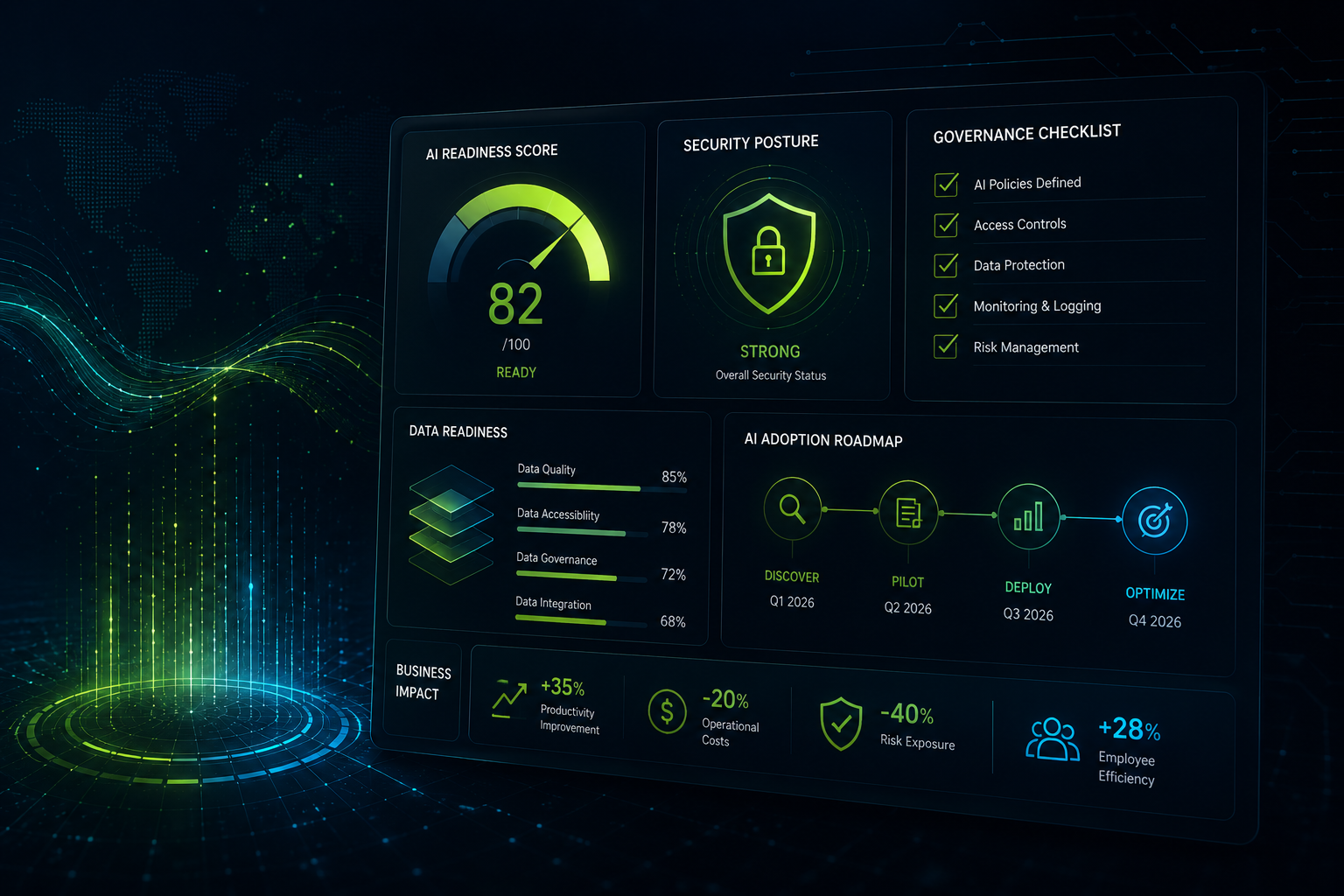
An AI Readiness Assessment evaluates an organization’s preparedness for AI adoption across seven key pillars, including Business Strategy, AI Governance and Security, and Data Foundations, helping to identify strengths and areas for improvement. The assessment should evaluate six key factors: Data Quality and Governance, Infrastructure Scalability, Strategic Alignment, Talent and Skills, Culture and Change Management, and Ethical Governance and Risk.
Business strategy alignment: Successful AI implementation requires a clear organizational strategy that outlines needs for the short and long term, ensuring alignment with business goals. A well-defined strategy that outlines an organization’s needs for the next quarter, year, and five years is essential.
Data readiness: Assessing data infrastructure is vital for AI readiness; organizations must ensure their data is high-quality, accessible, and sufficient to train AI models effectively, which can significantly impact the success of AI initiatives.
Technology and infrastructure: A strong technological infrastructure is essential for AI implementation, as it must align with best practices and support the necessary AI capabilities.
AI governance: Define acceptable use policies, role-based access, logging requirements, and ownership for AI decisions.
Security controls: Evaluate MFA, endpoint protection, data loss prevention, and identity management.
Workforce readiness: Identifying skill gaps within the organization is crucial for AI implementation, as it ensures that the necessary expertise is available to build, use, and maintain AI systems.
Compliance posture: Assess how AI interacts with HIPAA, CJIS, PCI DSS, and state privacy laws.
Change management: Organizational culture plays a critical role in AI implementation; a culture that embraces change and innovation is necessary for successful adoption of AI technologies.
Signs Your Organization May Not Be AI-Ready Yet
Organizations often face challenges in AI initiatives due to a lack of foundational capabilities, which can lead to isolated projects that fail to deliver expected results and business value.
Watch for these indicators:
- No documented AI policies or guidelines
- Shadow AI is common—staff use ChatGPT or Copilot with client data
- No approved AI vendors or platforms vetted by security
- Data scattered across personal drives with unclear ownership
- No AI adoption roadmap, budget, or defined first step
- New AI tools purchased without cybersecurity review
- One enthusiast drives experimentation without cross-functional input
These signs underscore why a structured assessment matters before scaling AI across departments.
How SMBs Can Safely Scale AI Adoption
A strategic roadmap for AI adoption prioritizes projects that deliver immediate value and ensures that AI investments are aligned with core business goals. Identifying ROI opportunities is crucial for organizations looking to implement AI, as it helps pinpoint areas where AI can provide the most significant benefits, such as automating repetitive tasks and improving operational efficiency.
Phased implementation: Start with discovery and pilot phases before full deployment, with clear success metrics.
Governance frameworks: Establish an AI governance committee, define decision rights and review cadence.
Usage guidelines: Create plain-language rules about what data is allowed and when human oversight is required.
Secure AI enablement: Enable AI within trusted platforms like Microsoft 365 rather than unmanaged consumer tools.
Employee education: Provide training on AI benefits, limits, and responsible use practices.
Continuous improvement: Monitor usage patterns and refine policies based on feedback.

What Deerwood Technologies’ AI Readiness Assessment Includes
Deerwood Technologies brings cybersecurity expertise to AI readiness. The assessment process typically involves identifying ROI opportunities, analyzing data infrastructure, and assessing AI feasibility to ensure that organizations can effectively implement AI solutions.
- Structured discovery session: 60-90 minute executive and IT workshop to understand goals and current experiments
- Cybersecurity-first review: Evaluation of existing defenses in context of AI security risks
- Detailed AI readiness checklist: Structured questionnaire covering strategy, data, infrastructure, governance, workforce, and compliance
- Risk mitigation and governance design: Policy templates, approval workflows, and role definitions for SMBs
- AI adoption roadmap creation: Quarter-by-quarter implementation strategy prioritizing low-risk, high-value use cases
- Integration with managed services: Recommendations connect with our managed IT, managed security, cloud services, and disaster recovery offerings
- Executive-ready report: Concise summary with key factors, prioritized initiatives, and clear next steps
Taking the First Step: Download the Guide and Schedule Your Assessment
Your AI journey begins with understanding where your organization stands today.
- Download Deerwood’s AI Readiness Guide for a structured overview and checklist to bring to leadership discussions
- Schedule a formal AI readiness assessment to move from theory to an actionable roadmap for your business
The initial conversation focuses on understanding your current state—no technical preparation or system access required. Partnering with a cybersecurity-first MSP like Deerwood reduces AI security, compliance, and operational risks while helping you realize productivity gains.
FAQ: Practical Questions About AI Readiness for SMBs
How long does an AI readiness assessment typically take for a small or midsize business?
Deerwood’s assessment is usually completed in 2-4 weeks, including stakeholder interviews, policy review, and report preparation with minimal disruption to operations.
Do we need advanced technical skills in-house before starting?
No advanced AI or data science skills are required. The assessment is designed for business and operations leaders, with Deerwood providing technical and cybersecurity expertise.
Will the assessment require direct access to our sensitive data?
Early phases focus on architecture, processes, and governance. When data reviews are needed, they occur under strict confidentiality and least-privilege access controls.
What types of organizations benefit most from this assessment?
Regional manufacturers, healthcare clinics, financial services firms, local government, and SMBs with compliance obligations or limited internal IT staff see the greatest value from a structured AI readiness assessment.